
Wildfire work does not fit generic software
Wildfire protection spans property risk, engineering design, field delivery, public emergency data and continuous monitoring. No off-the-shelf platform covered that chain, so the work was being held together by spreadsheets, email and the memory of the people doing it.
A risk assessment lived in one place, the design in another, the materials list in a third, and the customer heard about none of it until someone found time to write it up. Every handover was a re-entry of the same property, and every re-entry was a chance to lose the detail that mattered — the fuel at the fence line, the water source, the access road that a truck cannot use in August.
The alternative was not to buy a bigger system. It was to build the specific tools the work needed, in the order the work needed them, and to keep one record of the property from the first enquiry to the annual service visit.
One property, followed from first click to annual service
The relationship can begin with a free address assessment and continue through consultation, design, engineering, installation, monitoring, alerts and service. Information collected at the address follows the work forward instead of being typed again at each stage.
- 01
Discover
A household finds wildfire information and a free address assessment before anyone tries to sell them a system.
- 02
Assess
The property’s own exposure is established from its real location, terrain, surrounding fuel and wildfire history.
- 03
Consult
A specialist works from that assessment, so the first conversation starts with the property rather than a blank form.
- 04
Design
Coverage, routing, zones and components are laid out on the actual building and carried into materials and quotation.
- 05
Deliver
The crew installs from the same record that was designed and quoted, and the property is certified on completion.
- 06
Monitor
After handover the property stays live: system status, wildfire and evacuation alerts, and service history in the Customer App.
Software in daily use, not a roadmap
These are the strongest figures in the audited record. Each one is stated once in this document as a figure, and mirrored CRM populations are never added together.
During a recent 30-day period, our wildfire-focused website recorded 249,787 unique sessions, as people accessed wildfire information and related resources to better understand what was happening around their homes and communities. Analytics verifies unique sessions, not deduplicated individual people. 249,787 is sitewide wildfire-focused traffic across the 30-day window, including the live fire-map pages; it is a session count and is never presented as a count of people. The Portal manages 5,421 CRM deals and the Website mirrors substantially the same population for reporting; only the Portal figure is published, because the two are the same work seen twice.
Sources: Website analytics snapshot (30-day window); Prodigy app administrative user record read and Property ledger; Training Academy Module and Progress ledgers; Bigin CRM Stage_History and FormSubmission sync timestamps; Portal deal records, August 2026 audit.
It starts with a real address, not a questionnaire
Risk Vision takes a property location and builds a structured risk position from wildfire history, terrain, surrounding fuel and authoritative public data. The customer sees what their exposure is and why, in language they can act on.
Controlled logic establishes the position. AI is used to explain that position in plain terms. A specialist remains responsible for anything that follows from it, which is why a report can be produced without a salesperson ever being involved.

- 01Real address as the starting point
- 02Structured risk position
- 03Plain-language explanation
Source: saved assessment records by resolved country, Website / Risk Vision, August 2026 audit.
Fourteen official sources, one view a household can read
EmberWatch brings wildfire and evacuation information from government and agency sources into a single customer-facing map, and keeps it useful before a visitor creates an account.
EmberWatch provides live wildfire information relevant to a user’s location, including active wildfire locations, status, proximity and distance from the user’s property, fire size, discovery and update times, and—where supplied by the responsible agency—containment status, cause, response information and links to official sources.
Relevance to a property is more than distance. Official status, the incident’s own record and the property’s own context all change whether a fire matters tonight, which is why a household is told what is happening near their address rather than handed a national map and left to judge.
Evacuation guidance follows the same rule as the rest of the system: controlled logic evaluates the options against the official incident, and the safety-critical decision is never handed to a language model.

- 01Official agency sources
- 02Active fires and evacuation notices
- 03Free, before any account
Fields listed are those verified in the live fire snapshot and official app records. Approach speed, wind direction and estimated arrival time are not standardised fields in that snapshot and are not claimed as such. Sources: EmberWatch health check and live fire snapshot (725 fires, 1 September 2026, all regional coverage probes passed); notification and delivery records, 16 August 2026; proximity records, two-week window, August 2026.
Protection that can run when nobody is home
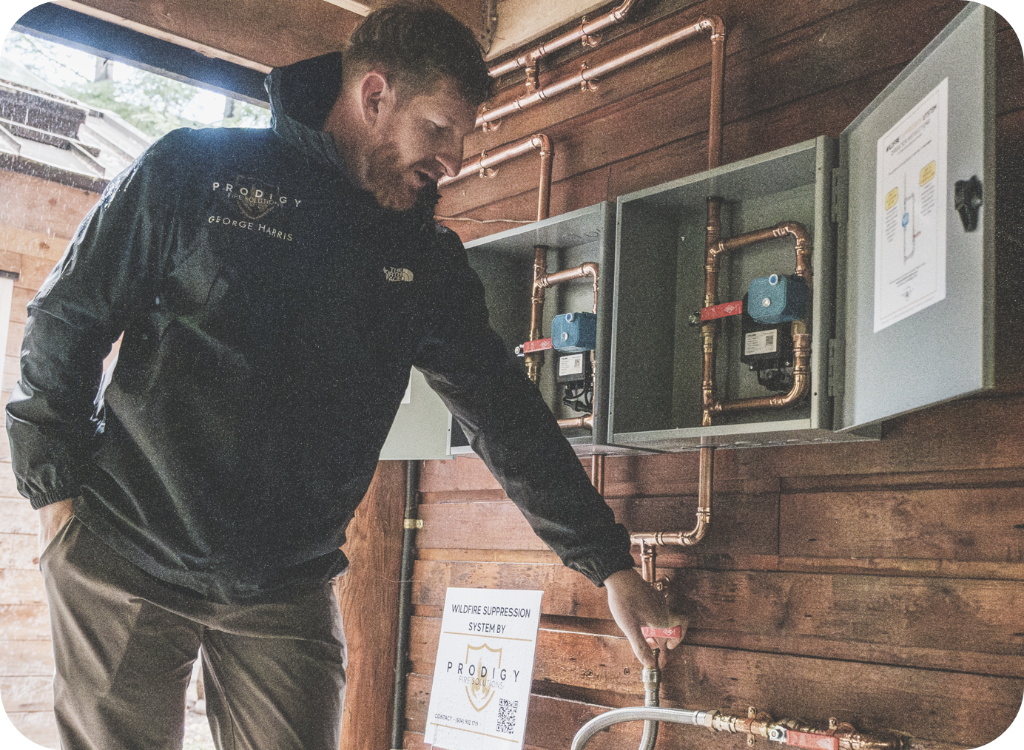
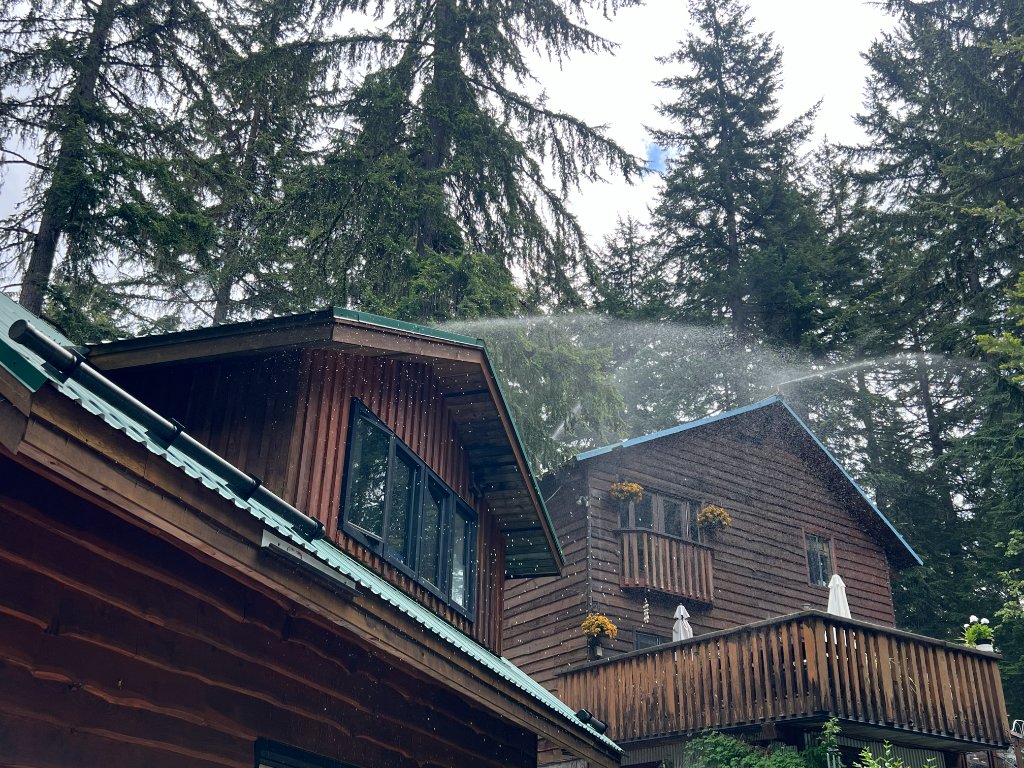
The system a customer buys is physical: heads on the roofline, valves, a control hub, water. SmartCycle coordinates that equipment through supported automation profiles so a property is not defenceless because its owners are three hours away.
Status is visible in the app, so an owner can see that the system is online before fire season rather than discovering otherwise during one. When something needs attention it is raised as a service exception and a person deals with it.
Source: device records and device health snapshot, Prodigy Wildfire App, August 2026 audit.
The relationship continues after the install crew leaves
Most protection products end at handover. The Customer App keeps the property live: monitoring, wildfire and evacuation alerts, household sharing, device status and service history in one place.
The Prodigy app has 736 registered user accounts and contains 506 monitored-property records, including 497 verified properties. EmberWatch was actively monitoring 725 fires across Canada, the United States, Australia and New Zealand when the live system was verified.

- 01Monitoring and alerts
- 02Device status
- 03Service history
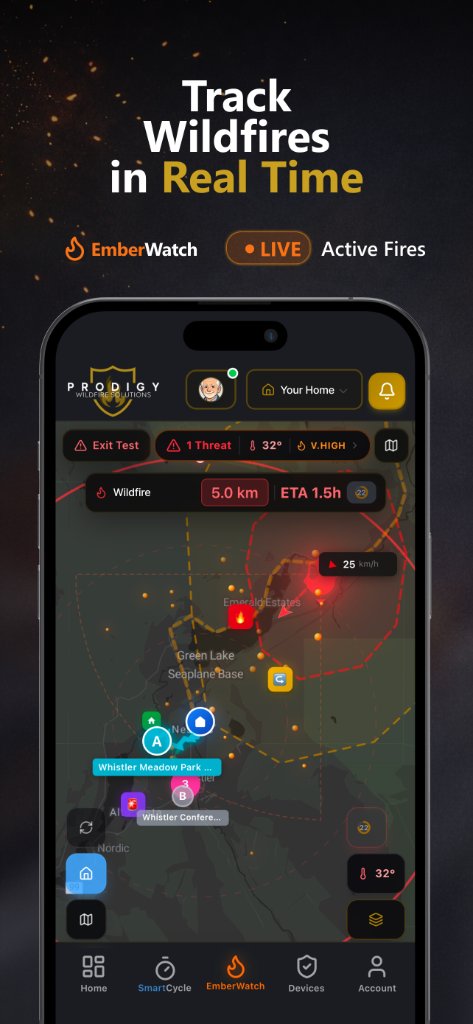
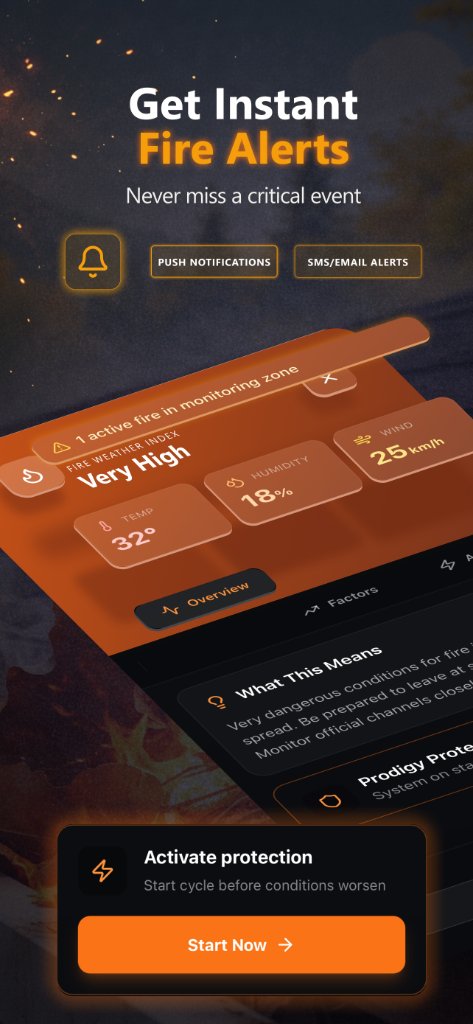
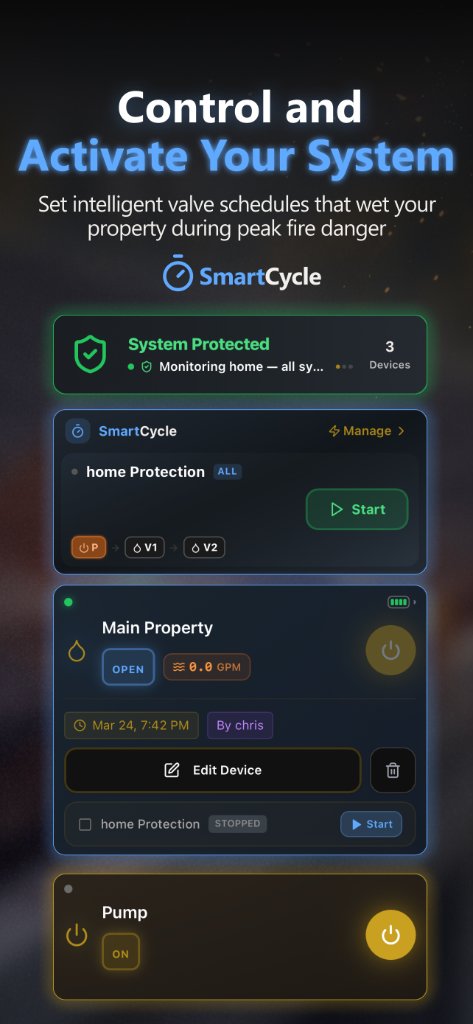
Registered accounts, property records and concurrent fires are three separate counts and are never summed into one adoption figure. All regional coverage probes passed at the health check. Sources: Prodigy app administrative user record read and Property ledger, 1 September 2026; household records, August 2026 audit.
Draw the property once, then reuse the truth
A browser-based design environment works on real aerial context: coverage, routing, zones and components on the actual building. One structured design then carries into materials, engineering, proposal, job record, work order and service certificate.
Automation assembles the repeatable engineering information. Technical review and professional accountability stay with the engineer who signs it, which is the only arrangement that survives contact with a building code.
The same record follows the crew to site, so the system that gets installed is the system that was designed and quoted, and the certificate at the end refers to the same property record the customer first asked about.
Source: Portal quote, job, work-order and certificate records, August 2026 audit.
Three tiers, one property record between them
The journey a customer experiences is carried by three operating tiers. Each tier owns a stage of responsibility and hands the next one a record rather than a summary, which is what stops the same property being described three different ways.
Address + risk context
A real property location is turned into a structured risk position, and public wildfire and evacuation information is kept usable for anyone, before an account or a salesperson exists.
Hands forward: the property, its exposure and the household’s own stated context.
Consultation + design
Specialists consult on that assessment, lay the system out on the building, and produce the engineered documentation a customer decides from. Training and manager sign-off decide who is trusted with the conversation; the CRM carries every enquiry to that person.
Hands forward: one approved design, its materials and the signed engineering record.
Field delivery + ongoing service
The crew installs from the approved record, the property is certified, and the relationship continues as monitoring, alerts, device status and scheduled service rather than ending at handover.
Returns to the record: certification, service history and the property’s live status.
CRM and automation help enquiries reach the right people and receive consistent follow-up. In August, the system tracked 335 leads reaching the sales funnel, compared with 77 in June—a 4.4-times increase in lead volume handled and tracked. Direct website enquiries are also being routed into the CRM in seconds, while scheduled social-lead imports typically arrive within 15 minutes. Stated as responsibility and information flow only. Internal architecture, decision thresholds, routing logic and device command behaviour are deliberately not described in this document.
Measured system throughput from Bigin Stage_History windows (335 ÷ 77 = 4.35, rounded to 4.4). Lead volume reflects the whole business in each window; it is not presented as a controlled result caused by automation alone. Source: Bigin CRM Stage_History and FormSubmission sync timestamps, 1 September 2026.
Practise the hard conversation before a customer hears it
Wildfire conversations are technical and often emotional. Employees work through the curriculum, practise with an AI counterpart, are assessed, and are reviewed by a manager before they are trusted with a live lead.
40 employees and installers have completed verified training through the Prodigy Wildfire Training Academy, including 37 who completed the Product Mastery — System Design and Engineering module.
A certificate here means an assessment was passed and a manager signed it off. It is not an attendance record, and no amount of AI coaching substitutes for that sign-off.
Assignment and rep administration are recorded events, not a performance score. No completion or success rate is claimed.
A Prodigy specialist at a laptop working through an Academy practice conversation, real office, natural light, over-shoulder framing, no faces identifiable
Replace with owner-supplied photography of a real training session, cropped 4:5 so this frame keeps its size.
Completion is counted per module from the Academy progress ledger: 40 completed the foundational module level, 37 completed Product Mastery — System Design and Engineering, and 24 completed the final module, What Bad Looks Like. No claim is made that all 40 completed every one of the 18 modules. Sources: Training Academy Module and Progress ledgers, 1 September 2026; module, practice and attempt records, August 2026 audit.
Where AI helps, and where it is not allowed to decide
The boundary is the same everywhere in the system, and it is easiest to see in the specific products rather than in a policy statement.
AI where it helps. Rules where they matter. Humans where responsibility belongs.
Source: Portal handoff events and website assistant conversation records, August 2026 audit.
What changed for the people on both sides of the work
For a customer, the change is that they can understand their own property before anyone tries to sell them anything, and that someone is watching it afterwards. For employees, the change is what they spend the day doing.
Work that used to be assembly — retyping a property, rebuilding a materials list, writing the same proposal paragraph again — is now produced from the project record. The time moves to consultation, exceptions, approval and the customer relationship, which is the part of the job that needed a person all along.
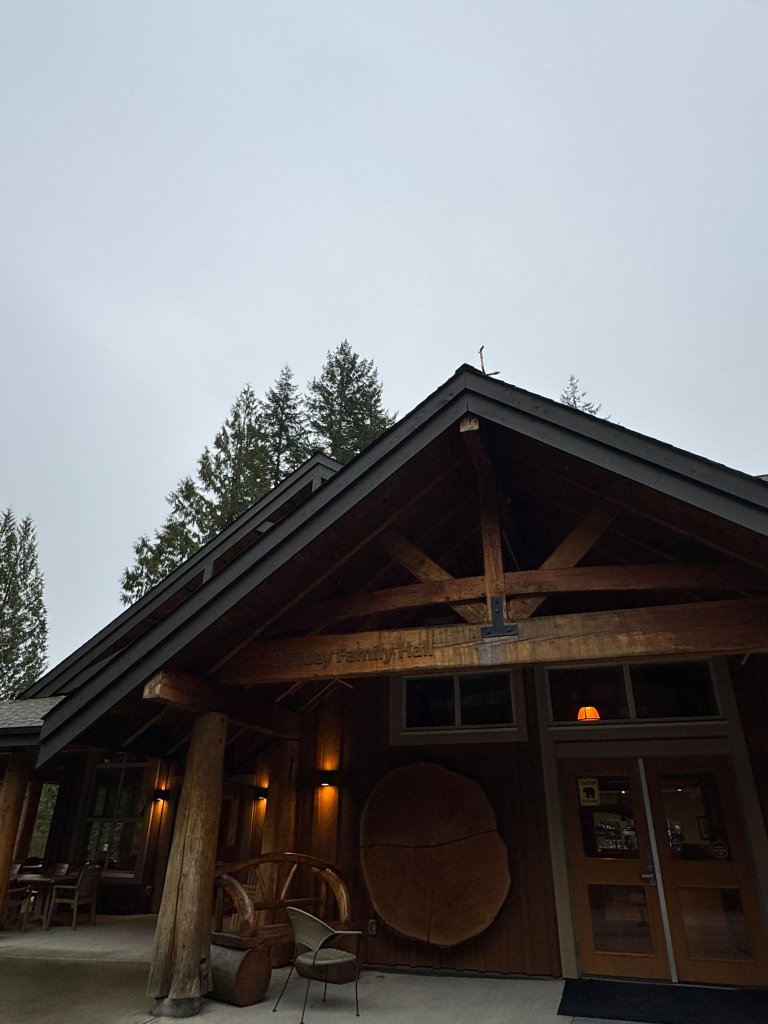
Knowledge that lived in one founder’s head is now in the workflows, rules, training material and reusable project structures, where a new employee can reach it in their first week instead of their third year.
Source: knowledge-base, question-bank and internal issue records, August 2026 audit.
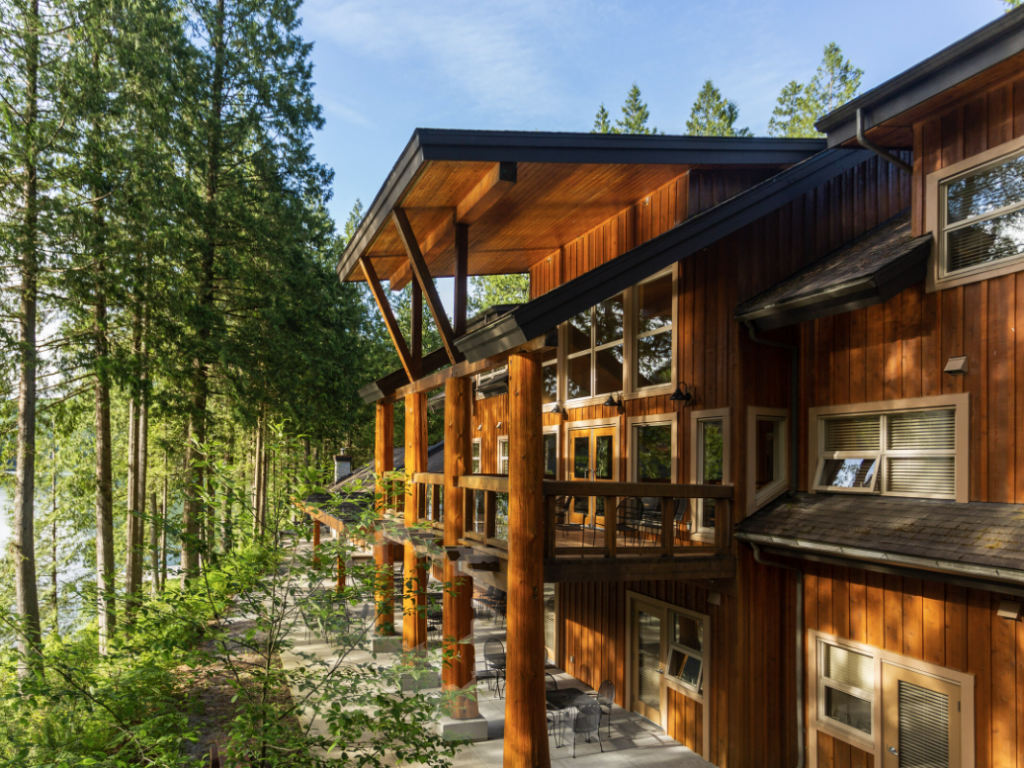
One standard, adapted to three markets
Canada, the United States and Australia run on the same operating model, with terminology, public data sources and process adapted to each. New Zealand appears only as selected technology and data support.
Source: property records by country, 16 August 2026 read of 473 records. The country split was not re-read on 1 September, so it is stated against its own base rather than the current 506-record total.
Current capability is one property at a time
Everything evidenced above operates at the level of an individual property. Portfolio and community uses are direction, not delivered product, and are labelled that way deliberately.
The audited, proven unit of work: assess, design, install, monitor, service.
Serving owners and managers who hold many properties at once.
Working alongside communities and partner networks at area scale.
Funding would accelerate productisation, partner experience and responsible expansion of workflows already proven at property level. It would not change what is claimed above as current.
Understand sooner. Act before the emergency.
Prodigy built this operating system so a household can understand wildfire risk earlier, and so the people protecting that household can act while there is still time to act.
- Website analytics snapshot (30-day window) · verified 1 September 2026
- Training Academy Module and Progress ledgers · verified 1 September 2026
- Prodigy app administrative user record read and Property ledger · verified 1 September 2026
- EmberWatch health check and live fire snapshot · verified 1 September 2026
- Bigin CRM Stage_History and FormSubmission sync timestamps · verified 1 September 2026
- Application Audits 09–12 (Portal, Website, Wildfire App, Academy record counts) · verified August 2026