57 Wildfire Research Stations Are Closing. Here's What It Means for Your Home.
2026-04-05
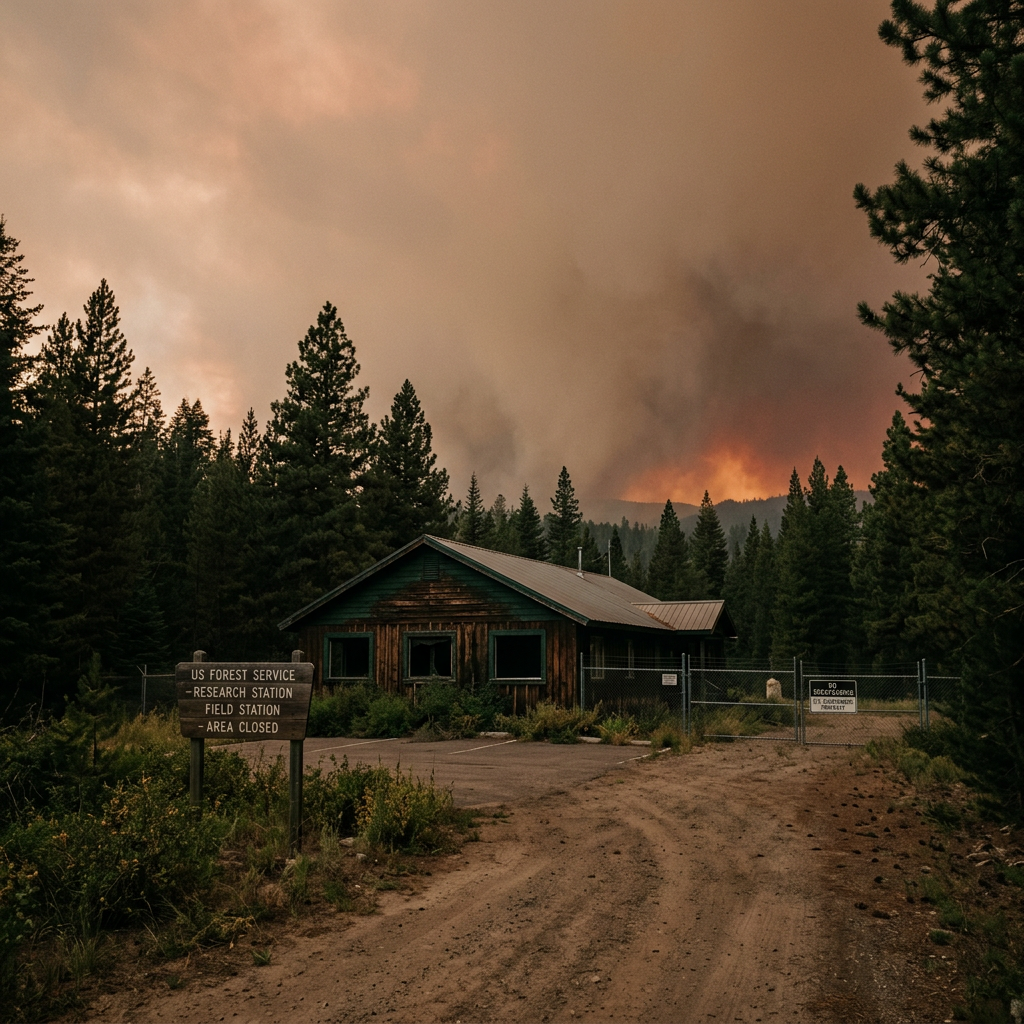
The U.S. Forest Service is shuttering 57 of 77 research facilities that study wildfire behaviour, drought, and forest management. With the science infrastructure shrinking, individual property protection has never been more important.
On March 31, 2026, the U.S. Department of Agriculture announced a sweeping reorganisation of the U.S. Forest Service. Among the changes: 57 of the agency's 77 research facilities across 31 states will be closed. The remaining research capacity will be consolidated into a single centralized office in Fort Collins, Colorado. The agency's headquarters is also moving from Washington, D.C. to Salt Lake City, Utah.
Original Analysis
This article is Prodigy's analysis of the wildfire protection implications arising from the USDA reorganisation announced March 31, 2026. We draw on reporting from multiple sources including the Salt Lake Tribune, PEER (Public Employees for Environmental Responsibility), and the USDA's own press release. All commentary and recommendations are original to Prodigy Wildfire Solutions.
What's Actually Happening
The Forest Service manages 193 million acres of forest and grassland across 43 states. Its research division — established in 1915 — operates field stations at universities, experimental forests, and laboratories where scientists study how wildfires spread, how forests recover, how drought and pests affect tree health, and how climate change is altering fire behaviour across different ecosystems.
Under the reorganisation, those 57 stations will close. Six in California. Five in Mississippi. Four in Michigan. Three in Utah. The Pacific Northwest Research Station in Portland — founded in 1925 with 246 employees, most of them scientists — is among the closures. Approximately 1,500 Forest Service scientists are affected, and employees report confusion about whether their research will continue to be funded or where they would be asked to relocate.
Forest Service Chief Thomas Schultz stated that the consolidation 'does not mean a retreat from the agency's research mission' and is about 'organizing the research enterprise more efficiently, not diminishing it.' But current employees tell a different story. One senior scientist told reporters they had no clarity on whether their work would be funded. Another said research into ecological and climate stressors is being downplayed, with established disciplines being lumped into a generic 'forest management' category.
"This move will lead to an increasing divergence between sound science and land management."
— Kevin Hood, Executive Director, Forest Service Employees for Environmental Ethics
The Precedent Is Not Encouraging
This is not the first time a federal land management agency has been reorganised through relocation. In 2019, the Bureau of Land Management's headquarters was moved from Washington to Grand Junction, Colorado. The result: more than 87% of the main office's employees resigned rather than relocate. The Biden administration reversed the move in 2021, but by then most of the institutional knowledge had walked out the door.
Forest Service employees expect a similar outcome. Scientists with decades of experience studying specific forest ecosystems — acid rain impacts in the Northeast, fire behaviour in the Pacific Northwest, drought patterns in the Southwest — will leave rather than uproot their lives and labs. That knowledge does not transfer to a centralized office. It simply disappears.
Why This Matters for Wildfire Season 2026
This announcement comes as much of the Western United States faces record temperatures and prolonged drought heading into summer. The research stations being closed are the same ones that produce the science used to predict fire behaviour, assess community risk, develop fuel management strategies, and evaluate whether prevention programs are actually working.
As PEER noted in their response, the administration did not inventory the scientific research needs of the National Forest System before announcing the consolidation. There was no assessment of which research programs are critical, which ecosystems require ongoing monitoring, or which projects are mid-stream and would be lost.
The practical consequence is straightforward: communities in wildfire-prone areas will have less publicly funded science informing their protection. Fewer researchers will be studying local fire behaviour. Fewer models will be built. Fewer policy recommendations will be published. The knowledge gap will widen exactly when the risk is accelerating.
What This Means for Homeowners
This is a pattern we have documented before. After the 2025 LA wildfires, the Independent Institute's retrospective showed that every external system meant to protect homeowners — fire services, water infrastructure, insurance, utility oversight — either failed or was overwhelmed. The closure of wildfire research stations adds another layer to that same pattern: the public infrastructure that is supposed to understand and mitigate wildfire risk is being reduced.
None of this means that wildfire risk is decreasing. Drought is intensifying. Development in the wildland-urban interface continues. Fire seasons are lengthening. What is decreasing is the institutional capacity to study, predict, and advise on those risks.
"The risk is accelerating. The science infrastructure meant to understand it is contracting. The gap between those two realities falls on individual property owners."
For homeowners in wildfire-prone areas, the implication is the same conclusion we drew from the LA fires analysis: the protection you can rely on is the protection you control yourself. When public systems are under-resourced — whether that means fire hydrants losing pressure or research stations closing — individual preparedness becomes the primary line of defence.
What You Can Do Right Now
Practical Steps for Homeowners
- Assess your risk — Use our free Wildfire Risk Assessment to understand your property's specific exposure, based on vegetation, terrain, and historical fire data
- Harden your property — Ember-resistant vents, non-combustible roofing, and cleared defensible space are baseline measures every homeowner should implement
- Install active suppression — A permanently installed exterior sprinkler system gives you the ability to saturate your property during a fire event, independent of fire service response
- Plan for self-reliance — Ensure your protection systems work without municipal water pressure, grid power, or anyone else showing up
- Stay informed — Monitor tools like EmberWatch for real-time fire activity near your property, especially as public monitoring resources contract
Understand Your Property's Risk
With federal research capacity shrinking, knowing your specific wildfire exposure is more important than ever. Take our free Wildfire Risk Assessment — it analyses your property's vegetation density, terrain slope, historical fire proximity, and ember travel risk in under two minutes.
Sources: USDA Press Release (March 31, 2026); Salt Lake Tribune reporting by Eric Niiler / The New York Times (April 4, 2026); Public Employees for Environmental Responsibility press release (April 2, 2026); National Today / Fort Collins (April 3, 2026). All analysis, commentary, and recommendations are original to Prodigy Wildfire Solutions. Read the USDA announcement → · Read the PEER analysis →
Is your property at risk?
Get your free wildfire risk assessment
Two minutes, address-level analysis, no account required — see your property's risk score and what's driving it.
Run my free assessment