
Hell's Gate Wildfire: A Suspected Human-Caused Ignition Confirms BC's 2026 Season Has Already Begun
2026-04-25

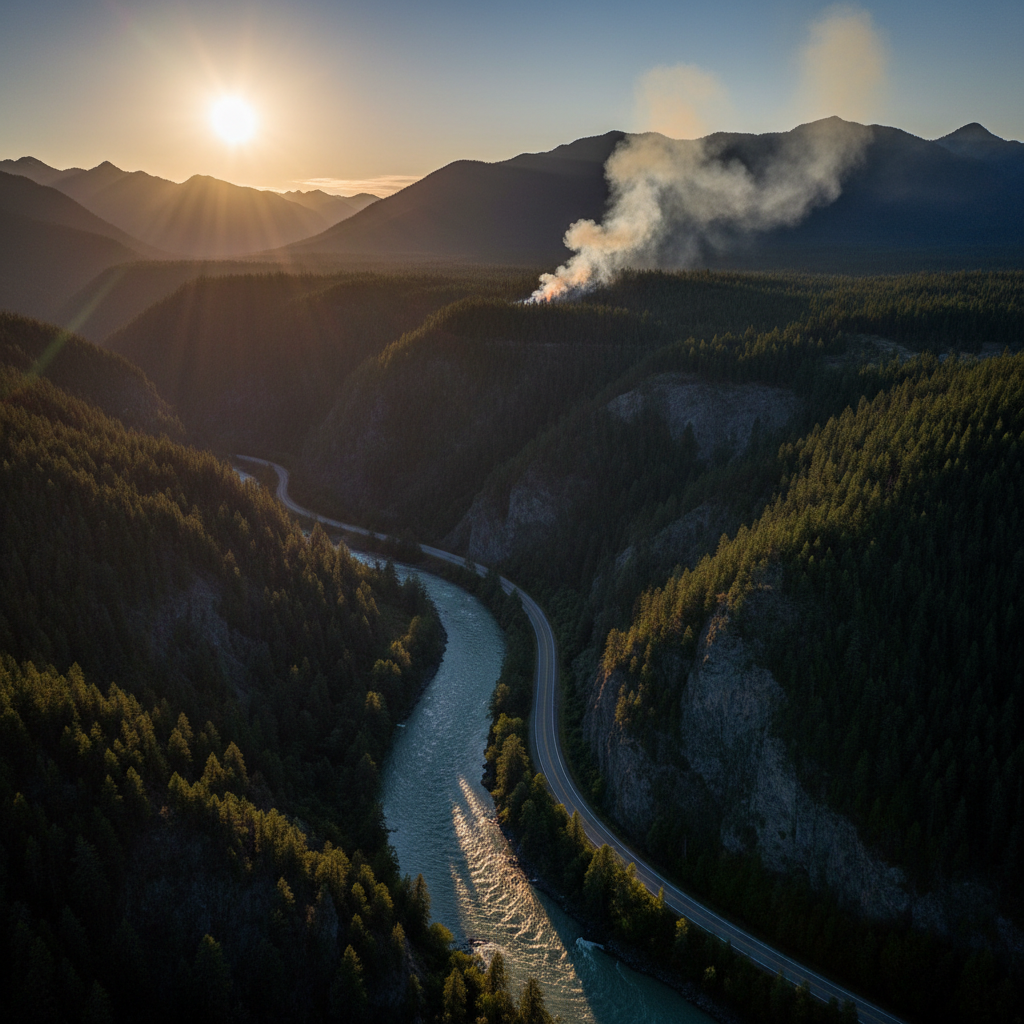
BC Wildfire Service crews are responding to a new fire east of Highway 1 near Hell's Gate in the Fraser Canyon — suspected to be human-caused. It's a stark reminder that wildfire season in British Columbia no longer waits for July.
BC Wildfire Service crews are responding to a new wildfire that sparked east of Highway 1 near Hell's Gate, in the steep timbered slopes of British Columbia's Fraser Canyon. Officials suspect the ignition was human-caused. The fire is small at the time of writing — but the location, the terrain, and the calendar are all worth paying attention to.
Original Reporting
This article is based on initial reporting by KelownaNow citing the BC Wildfire Service. Cause is described as suspected human-caused; investigation is ongoing. Conditions on the ground may have changed since publication.
Why Hell's Gate Matters
The Fraser Canyon is one of the most fire-prone corridors in British Columbia. The terrain funnels wind, the slopes are steep enough that fire moves uphill at running pace, and the timber on either side of Highway 1 is dense, dry, and continuous. Hell's Gate sits at the narrowest point of the canyon — a place where a fire spotted across the river can become a fire on both sides within hours.
"An April ignition in the Fraser Canyon isn't an outlier anymore. It's the new shape of the season."
The communities most exposed are the small, scattered settlements along the canyon — Boston Bar, North Bend, Spuzzum, Yale — and the rural properties tucked into the side drainages. These are areas where fire crews are skilled and committed, but where road access is single-threaded, water sources are limited, and a single ignition in the wrong wind can isolate residents within an evacuation alert window measured in minutes, not hours.
Human-Caused Means Preventable — and Repeatable
When the BC Wildfire Service flags a fire as suspected human-caused, the implication isn't just that someone was careless. It's that the fire didn't need to happen. And because conditions are already dry enough that an April ignition can take hold in steep timber, the next one is a matter of when, not if.
What 'human-caused' typically means in BC's interior
- Discarded cigarettes along highway pull-outs and rest stops
- Sparks from chainsaws, brush cutters, and ATV exhausts contacting dry grass
- Trailer chains dragging on pavement, throwing sparks into roadside fuel
- Unattended or under-extinguished campfires in informal pull-outs and forestry roads
- Hot vehicles parked over dry grass — catalytic converters routinely exceed ignition temperature
What This Tells Us About 2026
An ignition that takes hold in late April in the Fraser Canyon means the forest is already receptive. Snowpack at lower elevations is gone, fine fuels are cured, and relative humidity in the canyon corridor has dropped to summer-like levels weeks ahead of historical norms. That doesn't tell us 2026 will rival 2023 or 2024 — fire seasons are not linear — but it tells us the runway is short. The window for homeowners to prepare is closing now, not in June.
What Homeowners Should Be Doing This Week
Five practical actions before May long weekend
- Clear roof valleys, gutters, and decks of pine needles and dead leaves — these are ember collectors
- Move firewood, propane tanks, and combustible patio furniture at least 10 metres from any wall
- Test irrigation, pumps, and any existing exterior sprinklers before you actually need them
- Confirm your evacuation plan with everyone in the household, including pets and livestock routes
- Walk your defensible space honestly — if a fire crew can't drive a truck around your home, neither can a hose
The Gap That Hardening Alone Can't Close
FireSmart practices — vegetation management, fire-resistant materials, defensible space — reduce the probability your home ignites. They are essential. But during a fast-moving canyon fire driven by upslope wind and ember showers, passive measures alone are not always enough. Embers don't respect setbacks. They land on roofs, in gutters, against siding, and in the dry duff at the base of fences, and they keep landing for hours.
"Hardening reduces the odds. Active suppression changes the outcome. You need both."
This is why Prodigy designs and installs permanent exterior sprinkler systems engineered for British Columbia conditions: roofline coverage that wets the structure, deck, and defensible perimeter; freeze-resistant plumbing for canyon winters; integration with wells, tanks, lakes, or pools; battery-backed and generator-compatible operation for when the power drops; and remote activation from the Prodigy Wildfire app so you can defend your property from an evacuation centre, not your driveway.
The Bottom Line
One small fire near Hell's Gate is not, by itself, an emergency. But it is a signal — and the signal is consistent with what we've been telling Canadian homeowners for three years running. The season starts earlier than it used to. The terrain matters more than the date. Human-caused ignitions are not going away. And the homeowners who are still safe in October will be the ones who decided, in April, that 'next year' was the wrong answer.
Get a Free Wildfire Risk Assessment
Find out exactly how exposed your property is — fire history, terrain, vegetation, and the specific protection plan we'd recommend. Free, no obligation, takes two minutes. Available across BC, Alberta, and every Canadian province.
Is your property at risk?
Get your free wildfire risk assessment
Two minutes, address-level analysis, no account required — see your property's risk score and what's driving it.
Run my free assessment