
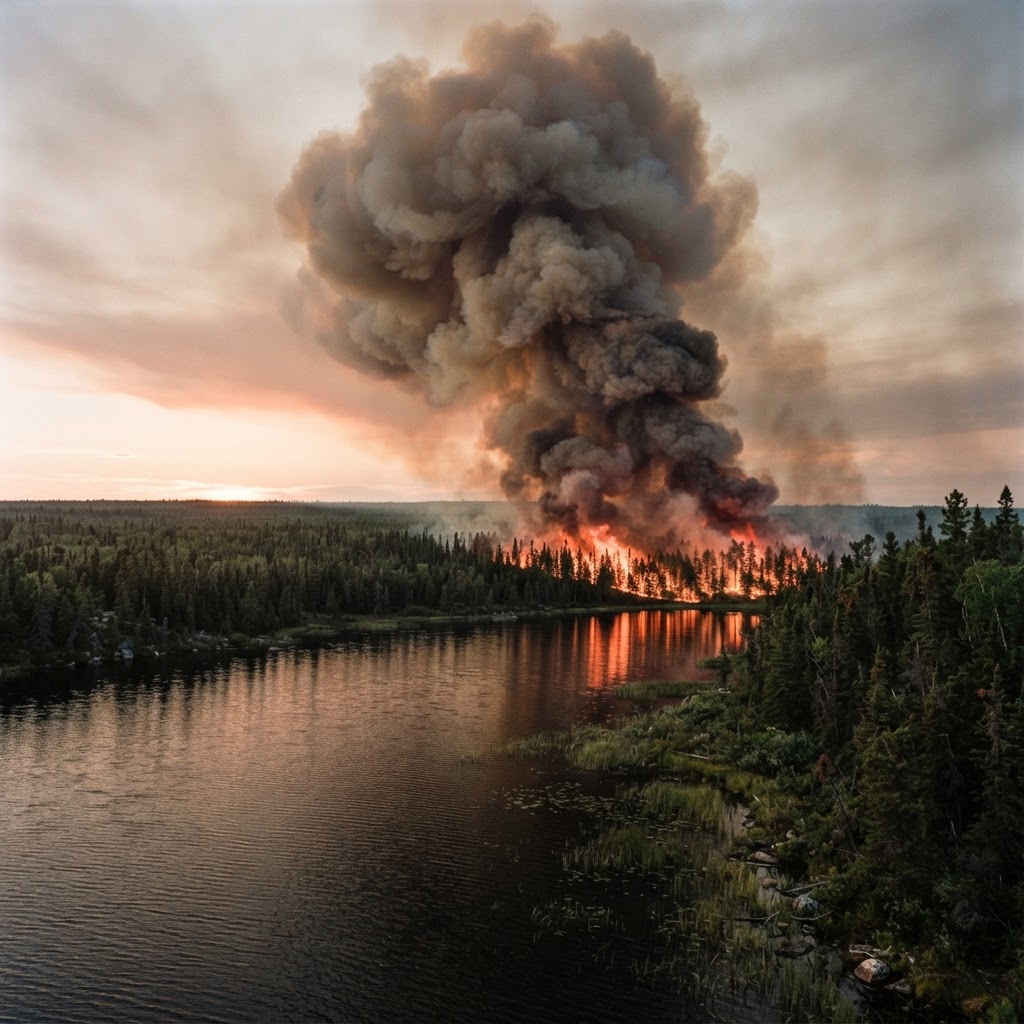

When Canadian wildfire agencies decide a town is worth saving, they don't reach for a theory. They reach for sprinklers. Structure protection units — trailers of pumps, hose and sprinkler heads — are now standard doctrine in British Columbia, Alberta, Nova Scotia and beyond. CBC called the result a "wall of water." The evidence from a decade of deployments is the strongest proof-of-concept in the country.
The Track Record Fire Agencies Don't Advertise
Post-incident reports from Canada's worst fire seasons keep returning to the same quiet hero:
Logan Lake, BC — 2021
The Tremont Creek fire burned 63,000 hectares straight into a community of 2,100 people. Roughly 250 homes carried rooftop sprinklers installed through the town's FireSmart program. Every sprinkler-protected home survived. Logan Lake became Canada's flagship proof that community-scale sprinkler protection works.
Jasper, AB — 2024
A 100-metre wall of flame entered the townsite and 358 structures were lost — yet two-thirds of Jasper survived. Parks Canada credited structure protection crews and sprinkler lines soaking rooflines and critical buildings through the night among the reasons the historic downtown core still stands.
Nova Scotia — 2023 & 2025
As major fires burned near Halifax and in Annapolis County, crews deployed hundreds of sprinklers around homes and critical infrastructure. CBC's reporting described the tactic in three words: "a wall of water." Manitoba cottage country has run the same playbook for years.
The Uncomfortable Question
If sprinkler protection is what professionals deploy when a community's survival is on the line — why does it arrive on a trailer, days into an emergency, only where crews can reach?
The honest answer from every fire agency: capacity. There are never enough structure protection units for every threatened community. In 2023, Canada's worst season on record, 18.5 million hectares burned and crews were triaging entire regions. A town that gets an SPU is a town that got lucky with logistics.
The Deployment Gap
Agency sprinkler protection is reactive, temporary and rationed. It must be trucked in, set up under emergency conditions, and taken away afterwards. A permanently installed system is the same proven concept — pumps, lines, engineered coverage — made proactive, permanent and yours, activated from your phone the moment EmberWatch shows fire approaching.
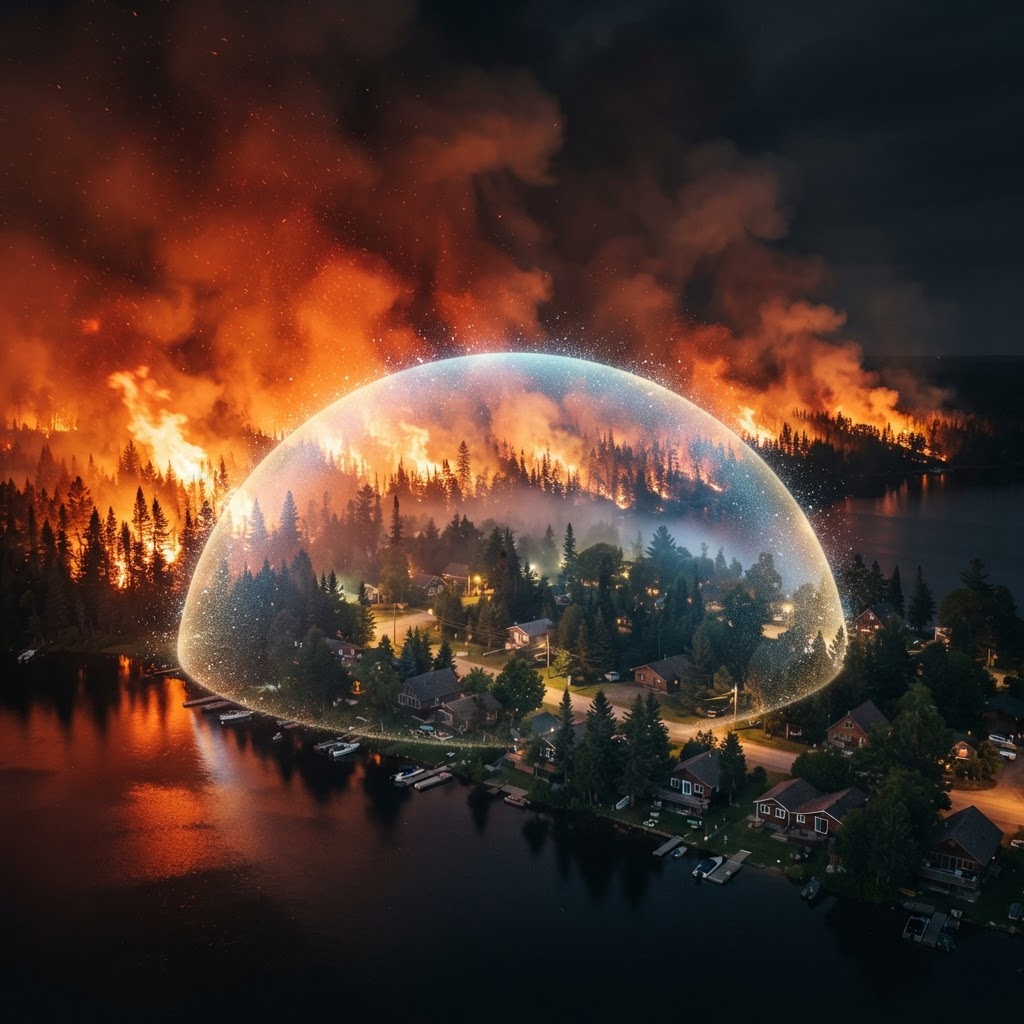
The Humidity Bubble, Made Permanent
What an SPU crew builds around a threatened home in six hours, a Prodigy system provides for decades: engineered nozzle coverage that saturates the roof, walls and defensible space, raising local humidity into a protective moisture envelope — a humidity bubble the ember storm cannot penetrate. Add detection sensors and remote activation, and the system defends your home while you're safe at an evacuation centre 100 kilometres away.
And just as Logan Lake showed, the effect compounds. Every additional protected home extends the moisture envelope across a neighbourhood. FireSmart community programs, strata councils and municipalities that coordinate installations aren't just protecting individual houses — they're building the permanent version of the wall of water that saved Jasper's downtown.
Sources & Further Reading
- FireSmart BC & BC Wildfire Service — community structure protection and rooftop sprinkler programs (firesmartbc.ca)
- CBC News — Logan Lake FireSmart sprinkler coverage during the 2021 Tremont Creek fire, and Nova Scotia sprinkler protection reporting, 2023–2025 (cbc.ca)
- Parks Canada — Jasper Wildfire Complex 2024 incident updates and structure protection summaries (parks.canada.ca)
- Natural Resources Canada — national wildfire statistics for the record 2023 season (natural-resources.canada.ca)
Statistics and case details are drawn from these publicly available reports and news coverage. All analysis and commentary is Prodigy Wildfire Solutions' own original work.