
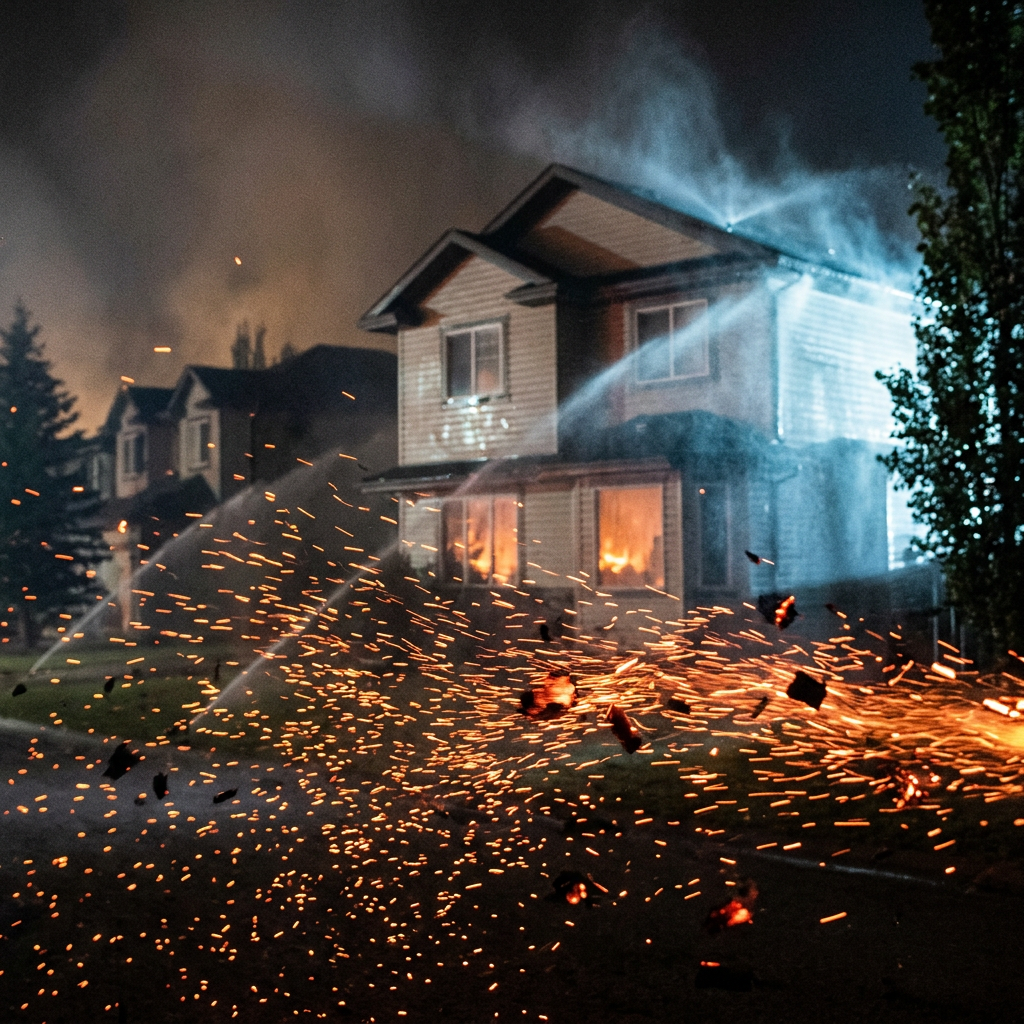

You've cleared the brush. Cleaned the gutters. Installed that fire-resistant roof. You feel prepared. Then you read a statement from the U.S. Forest Service that triggers doubt: "Up to 90% of homes destroyed by wildfires aren't ignited by direct flames, but by wind-borne embers." Suddenly, everything you've done feels incomplete.

The Destruction Mechanism Nobody Talks About
Here's what fire science reveals: the dramatic image of a wall of flame consuming a house — the visible fire front advancing — isn't actually how most homes burn in major wildfire events. The reality is far more insidious.
Embers — small, glowing fragments of burning vegetation — are launched into the air by convective winds above fire fronts. These embers can travel extraordinary distances, landing on roofs, in gutters, around vents, and against exterior walls miles ahead of visible fire.
Ember Attack
Wind-driven embers travel up to 2 kilometres ahead of visible fire fronts. They accumulate in re-entrant corners, against walls, in gutters, and around vent openings. A single ember landing in debris on a wooden deck can ignite a structure while the fire front is still a mile away.
⚠ PRIMARY DESTRUCTION MECHANISM
Accounts for 60–90% of structure losses depending on fire conditions
Radiant Heat
The IBHS (Institute for Business and Home Safety) has demonstrated that radiant heat from burning vegetation or neighbouring structures can ignite materials without any flame contact. Their research at the Near-Building Noncombustible Zone facility showed ignitions occurring within the 0–5 foot zone even with non-combustible ground cover.
Direct Flame Contact
The mechanism most people imagine — fire sweeping through and consuming a home. In reality, this accounts for the smallest percentage of structure losses. Homes are typically already burning from ember or radiant heat ignition before the flame front arrives.
The Ember Attack Timeline
Understanding the sequence is crucial. Here's what actually happens during a major wildfire event, based on post-fire analysis from events like the 2018 Camp Fire (Paradise, CA) and the 2021 Tremont Creek Fire (Logan Lake, BC).
Why Passive Measures Fall Short
This is uncomfortable to acknowledge, but it's scientifically clear: no amount of defensible space prevents embers from landing on your roof. Fire-resistant roofing still conducts radiant heat. Metal gutters don't prevent ember ignition in roof complexity points and vents.
Passive measures are valuable — they create favourable pre-conditions and reduce fuel loads around your home. But they're preparation, not protection. During the actual threat window of an active wildfire event, passive measures have already done their work. What happens next depends entirely on whether active defence exists.
What Active Defence Actually Does
Active wildfire sprinkler systems address the physical mechanisms of structure ignition at the molecular level. Here's the science:
Three Layers of Active Defence
Layer 1: Evaporative Cooling
Water applied to surfaces evaporates, absorbing heat energy. This drops surface temperatures below the ignition point of wood (approximately 300°C / 572°F) even when exposed to intense radiant heat. The physics is the same principle that makes sweating cool your skin — at an industrial scale.
Layer 2: Humidity Barrier
The evaporation process saturates the immediate air around the structure with moisture. This elevated humidity makes it physically impossible for embers to ignite dry fuel, even if they land directly on surfaces. The combustion chemistry simply doesn't work in a moisture-rich environment.
Layer 3: Sustained Duration
Engineered systems run for hours, not minutes. Unlike a garden hose or temporary sprinkler, these systems are designed to maintain protection throughout the entire threat window, often 4-8 hours during major fire events. This is critical because ember exposure isn't a single moment; it's a prolonged assault.
The Data: Camp Fire (Paradise) vs. Logan Lake
Two events. Two different countries. Nearly identical fire conditions. Dramatically different outcomes for protected homes.
The Path Forward
Defensible space remains valuable. Actively manage vegetation, maintain gutters, use fire-resistant materials. But understand what passive measures actually do: they create favourable pre-fire conditions that reduce — but don't eliminate — risk.
For active protection during actual wildfire conditions — when embers are raining, radiant heat is rising, and fire crews may not be able to reach your property — that requires engineered active defence.
The Science Is Clear
Passive measures are valuable groundwork.
Active defence determines survival.