
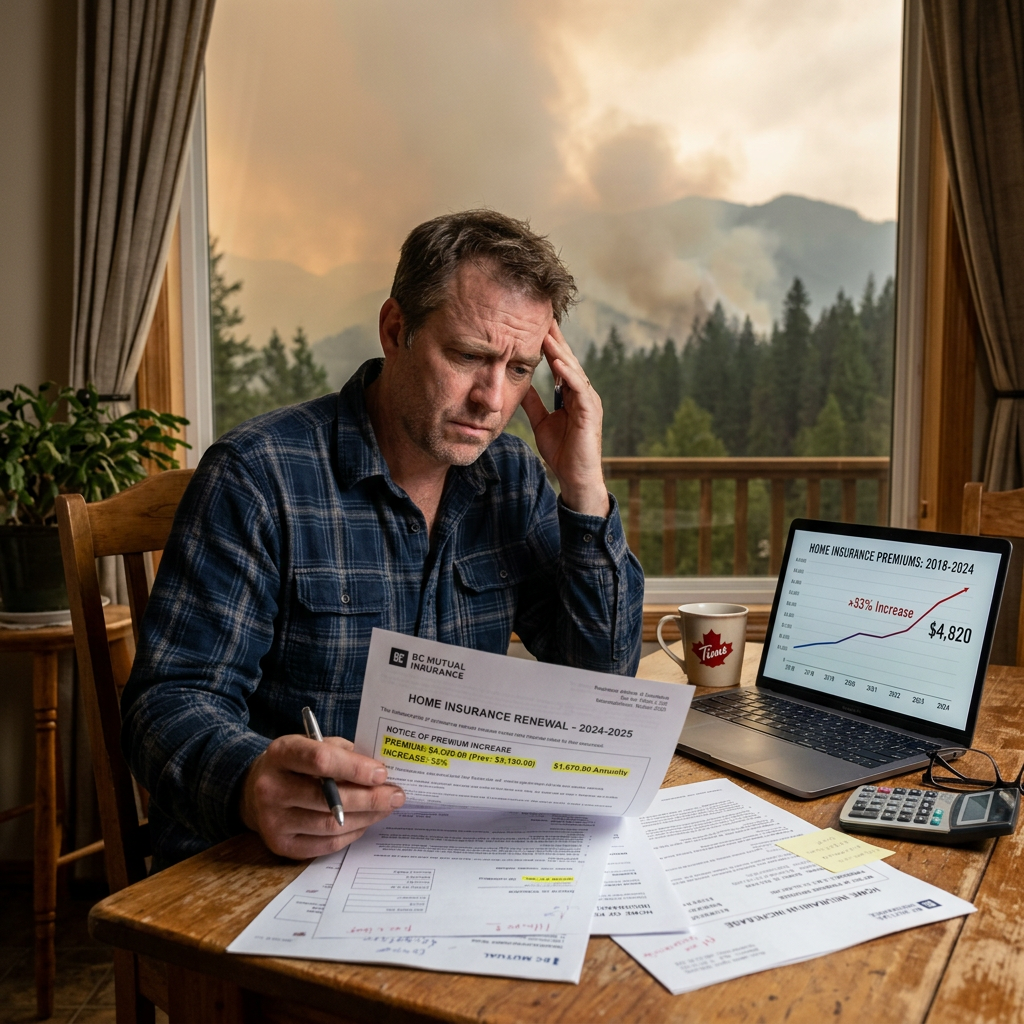

If you received an insurance renewal notice in the last twelve months and live in a fire-prone region of Canada, you've experienced what the Insurance Bureau of Canada diplomatically calls "pressure building." What you're actually experiencing is a fundamental recalibration of risk, one backed by $9.2 billion in insured losses in 2024 alone.

The Numbers That Tell the Real Story
In British Columbia, Alberta, and Ontario, property owners are seeing renewal increases that would have seemed impossible five years ago. The data from MyChoice Financial and Wahi's 2025 joint report paints a stark picture.
Premium Inflation: Worst-Hit Canadian Markets (2023-2025)
🇨🇦 Kamloops, BC
+98%
🇨🇦 Regina, SK
+59%
🇨🇦 Kelowna, BC
+52%
🇨🇦 Medicine Hat, AB
+24%
⚠ Insurance now = 19% of typical mortgage payment — highest in Canada
Source: MyChoice Financial / Wahi 2025 Home Insurance Report
This isn't temporary market volatility. This is actuarial science responding to structural change. When actual losses exceed predicted losses by significant margins — which they have in Canada for five consecutive years — companies respond with ruthless precision: raise prices or exit markets.
Four Forces Driving the Crisis
Liam McGuinty, VP of Federal Affairs at the Insurance Bureau of Canada, identified four converging forces in a 2025 address to the Fire Chiefs' Association. Understanding them is critical for any property owner planning their next move.
🔥
Escalating Disasters
Catastrophic fire losses jumped from $72M/year average (2005-2014) to $746M/year (2015-2024). A ten-fold increase in one decade.
🏗️
Construction Cost Surge
Building costs up 68% since 2019. Lumber +30%, fabricated metals +43%, cement/glass +41%. Replacing what's lost costs dramatically more.
👷
Labour Shortages
Skilled trades shortages, especially acute in rural and fire-prone areas, extend rebuild timelines from months to years.
🏘️
Policy Failures
Canada is building 200,000 new homes in wildfire-exposed regions and 500,000 in flood zones. The risk pool keeps growing.
The Actuarial Shift
Here's what property owners often miss: insurance companies don't price based on location alone. They price based on loss probability.
A property in a fire-prone zone is one risk category. A property in a fire-prone zone with professionally engineered protection is an entirely different category.
Research from multiple fire events shows protected structures have ignition rates 85-95% lower than unprotected properties in identical scenarios. Insurers know this. And they're now offering explicit discounts to reflect it.
The Alberta Breaking Point
Alberta provides the clearest warning of where the market is headed. In 2024, the provincial personal property insurance market operated at a loss — paying out $1.18 in claims and operating costs for every dollar collected in premiums. That resulted in a -11% return on equity for Alberta personal property insurance.
Alberta 2024: Insurance Industry Economics
$1.18
paid out per $1 collected
-11%
return on equity
$9.2B
national insured losses 2024
Source: Insurance Bureau of Canada, "State of the Home Insurance Market" (2025)
When insurers lose money on a sustained basis, they don't absorb losses indefinitely. They exit markets. This is already happening in California and Australia. The IBC report explicitly warns: "Canada must act before the situation reaches a crisis, as it has in other jurisdictions."
The Strategic Window Is Closing
We're in a transition period. Insurance markets are still available. Prices are rising but policies can still be obtained. The window for property owners to act proactively, installing protection that demonstrably reduces risk, is open but narrowing.
Over five years, the financial cases converge. But only one leaves your property actually protected. Only one maintains operational continuity if fire threatens. And only one tells your insurer you've reduced their risk exposure.
The Timeline Matters
Insurance markets don't forgive latecomers.
Properties positioning themselves advantageously are doing it now.