Select a layer to follow its role. Assemble the system to see how it connects.
Illustrative system anatomy
Conceptual component relationships. Not a site plan or a coverage guarantee.
Layer 01 / Roofline
The building sets the geometry.
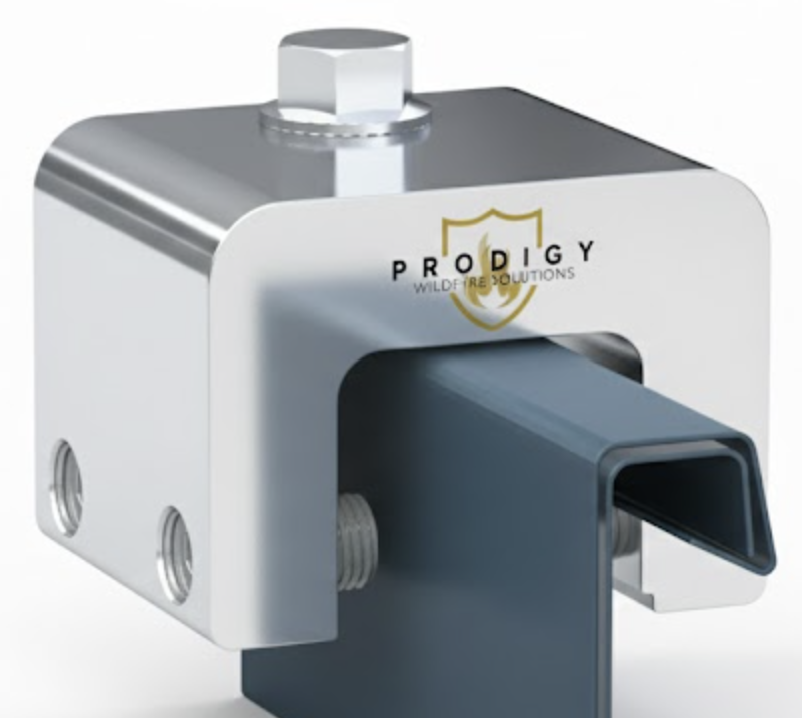
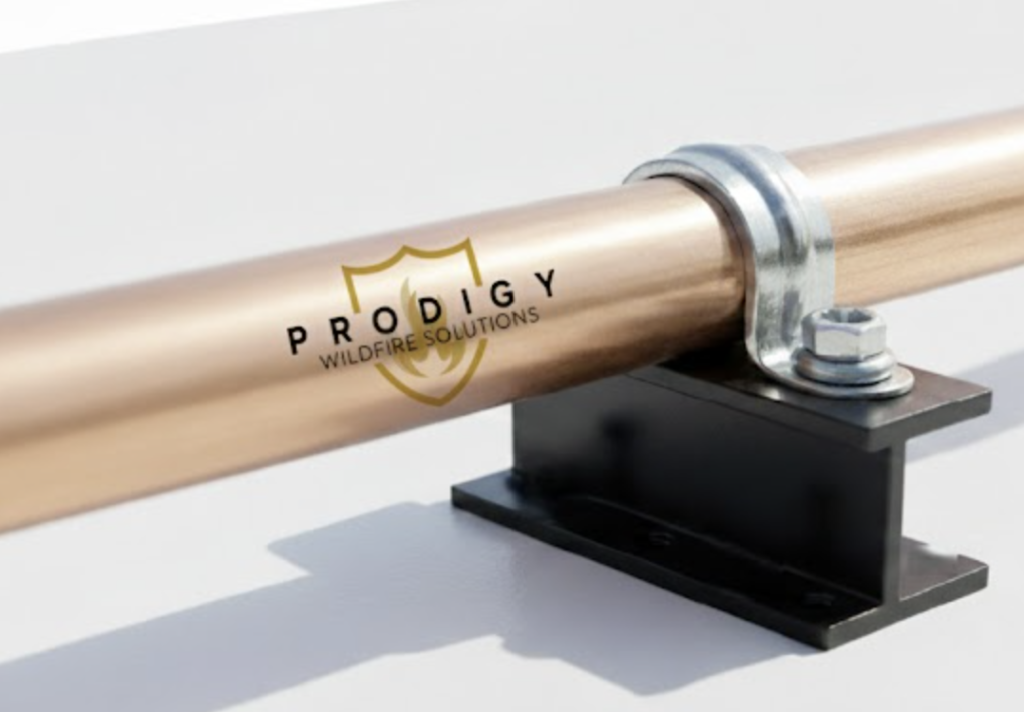
Permanent distribution lines trace the ridges and eaves. Sprinkler positions are designed around the shape of the roof and the surfaces that need water.
Type L copper distribution. Site-specific head placement.
01 / 06
02 / Follow the water
Every component. One continuous path.
The visible sprinkler is the end of an engineered chain. Follow the route to understand what makes it work.
SourceConfirm what water is available to the property.
Illustrative flow. Storage, pressure, output and operating duration are specified for each property.
03 / Activation mode
From a command to water on the property.
A visual demonstration. No real equipment is connected.
Simulation / not live telemetry
Ready
The illustrative system is waiting for a command.
ZONE 01 / StandbyZONE 02 / Standby
Demonstration timing is illustrative. Coverage and response depend on the installed design, water supply and conditions. Always follow official evacuation directions.
Field detail / Permanent infrastructure04
04 / Architecture, not an afterthought
Designed for the site. Integrated into the building.
Permanent protection is a process, not a box of parts. The design connects the water source to the exposed surfaces while respecting the architecture.
01
Survey
Understand the structure, terrain, vegetation, water and power.
02
Design
Specify supply, pipework, sprinkler positions and coverage zones.
03
Integrate
Install permanent infrastructure with attention to the building’s architecture.
04
Commission
Test the installed system and walk through its operation with the property owner.
Local requirements matter. Design review considers the applicable building rules, wildfire guidance and site conditions in your region.
05 / Optional detection
Another signal. Closer to the property.
On-site detection can support automatic activation where specified. It complements—not replaces—wildfire mapping and official alerts.
Made in United Kingdom
Canada & USA / Optional hardware
Long-Range IR3 Flame Detection
The world's first optically enhanced long-range IR3 flame detector. When facing a wildfire approach path, Optect can identify flames several miles away, providing critical early warning that gives your system time to work and your family time to evacuate. Detects a single candle at 20m. Penetrates smoke by reading combustion wavelengths, not particles or images. Winner of Life Saving Solution of the Year. Featured on BBC.
View product specifications
Detection Range
Several miles
Response Time
<5 seconds
False Alarm Rate
<1 in 15 years
Published product specifications. Suitability and performance depend on deployment conditions and the selected hardware.
06 / The physical becomes connected
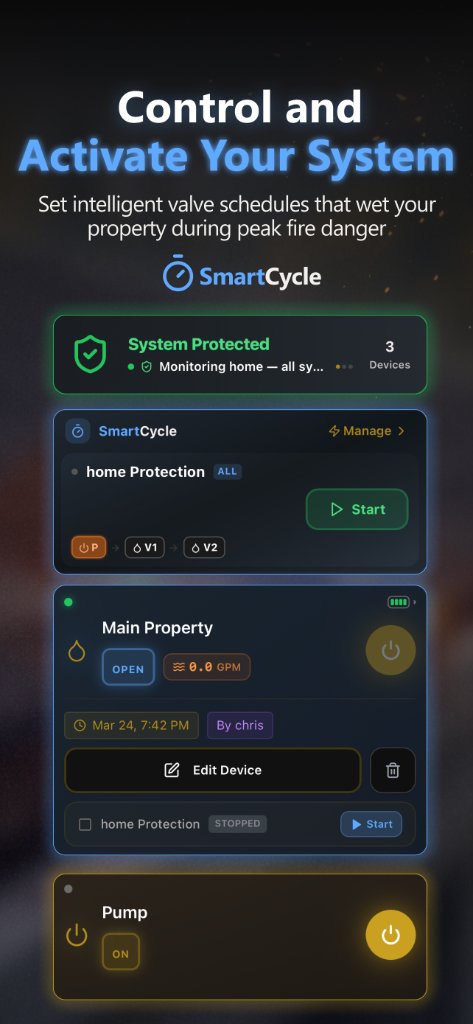
Installed on the property. Within reach in the app.
Explore the digital layer behind a connected Prodigy system—or start by understanding your own property’s exposure.
Prodigy Wildfire Solutions — Wildfire Protection Systems for Homes & Businesses
Exterior Wildfire Sprinkler Systems | Ember Attack Defence | USA, Canada & Australia
Prodigy Wildfire Solutions designs and installs permanent exterior wildfire sprinkler systems that create a protective humidity bubble around homes and businesses. Our engineered wildfire defence systems protect against ember attack, radiant heat, and direct flame contact. Serving the USA, Canada, and Australia with NFPA, FireSmart, and BAL-compliant wildfire protection.
Wildfire Protection for Homes
Protect your home from wildfire and bushfire with a permanent exterior sprinkler system. Residential projects are custom-engineered for each property (from AUD 30,000 in Australia). Installation completes in one day. Remote app activation from anywhere in the world. Defend against ember attack — the cause of 90% of wildfire and bushfire home losses.
Commercial Wildfire Protection
Prodigy commercial wildfire sprinkler systems protect resorts, tourism infrastructure, utilities, wineries, and business properties. Scalable from single buildings to multi-structure campuses. Notable installations include the Banff Gondola and Golden Skybridge. Systems from $25,000 to $1.2M+.
Free Wildfire Risk Assessment
Get your free AI-powered wildfire risk assessment in 2 minutes. Enter your property address and receive a personalised risk score, nearby fire history, key risk factors, and tailored protection recommendations. Available for properties in the USA, Canada, and Australia.
How Wildfire Sprinkler Systems Work
Prodigy exterior wildfire sprinkler systems use roof-mounted nozzles to create a 360-degree humidity bubble around structures. The system includes ember detection sensors, remote smartphone activation, and programmable cycle times. Water saturates the building envelope — roof, walls, eaves, and surrounding vegetation — preventing ember ignition and reducing radiant heat absorption.
Wildfire Protection by Region
California wildfire protection and sprinkler systems. Colorado wildfire defence. Oregon and Washington fire protection. British Columbia wildfire sprinklers — FireSmart compliant. Alberta wildfire defence. Ontario fire protection systems. Australian bushfire protection — BAL-rated sprinkler systems for NSW, Victoria, and Queensland.
Ember Attack Prevention
Ember attack is the number one cause of home destruction during wildfires. Embers can travel over 20 kilometres ahead of the fire front at temperatures of 1,200°C. Up to 90% of homes lost in wildfires are destroyed by ember attack, not direct flames. Prodigy exterior sprinkler systems neutralise embers on contact.
Wildfire Insurance & Property Value
A permanent wildfire sprinkler system can help maintain property insurance coverage in fire-prone areas where insurers are withdrawing. Many insurers offer premium discounts for properties with permanent wildfire protection. Systems increase property value and transfer to new owners at point of sale.