
Prodigy Wildfire Solutions — Exterior Wildfire Sprinkler Systems for Homes and Businesses
EmberWatch
Live252 fires
InsightsProdigy Wildfire Solutions
As featured in print

Lancashire & North West Magazine

Why Homes Don't Have to Burn in a Wildfire

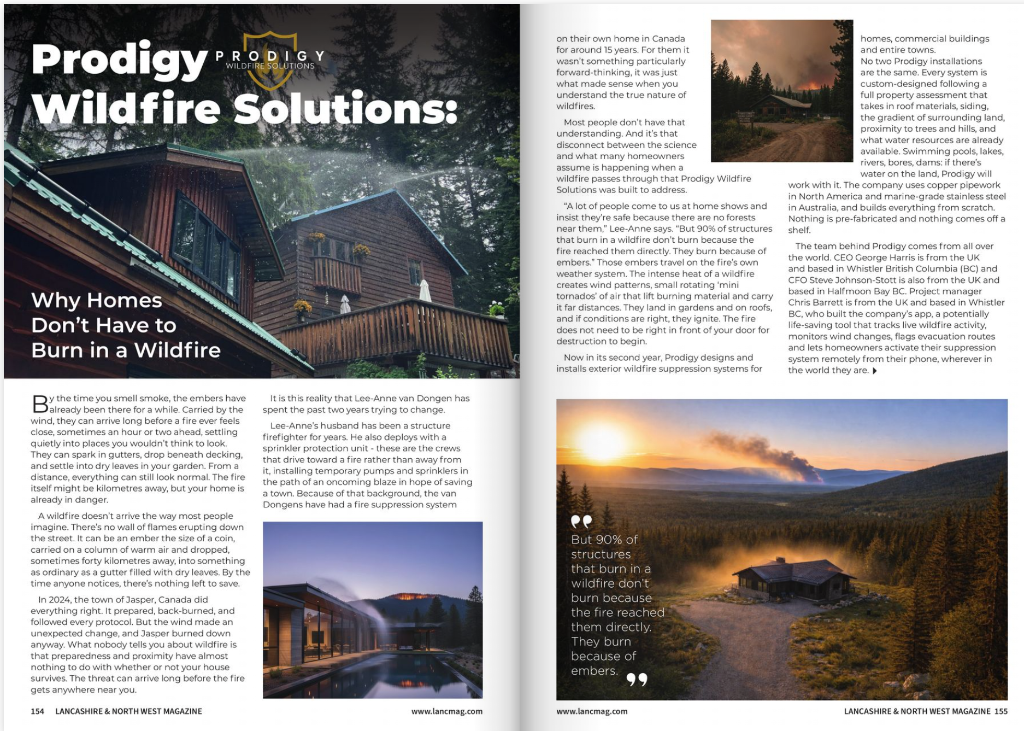
Prodigy Wildfire Solutions was invited into the pages of Lancashire & North West Magazine to explain a truth most homeowners never hear: the fire almost never reaches your house first. The embers do.

Pages 154–155·6 min read·Reprinted with permission

90%

of structures lost to wildfire are ignited by embers, not the fire front

40km

the distance an ember can travel ahead of a fire on its own wind

15 yrs

the van Dongens have had a suppression system on their own home

2024

Jasper did everything right, and the wind changed anyway

The feature, in full

As it appeared in Lancashire & North West Magazine, pages 154–155.

y the time you smell smoke, the embers have already been there for a while. Carried by the wind, they can arrive long before a fire ever feels close, sometimes an hour or two ahead, settling quietly into places you wouldn't think to look.

They can spark in gutters, drop beneath decking, and settle into dry leaves in your garden. From a distance, everything can still look normal. The fire itself might be kilometres away, but your home is already in danger.

A fire does not knock

A wildfire doesn't arrive the way most people imagine. There's no wall of flames erupting down the street. It can be an ember the size of a coin, carried on a column of warm air and dropped, sometimes forty kilometres away, into something as ordinary as a gutter filled with dry leaves.

By the time anyone notices, there's nothing left to save.

In 2024, the town of Jasper, Canada did everything right. It prepared, back-burned, and followed every protocol. But the wind made an unexpected change, and Jasper burned down anyway.

What nobody tells you about wildfire is that preparedness and proximity have almost nothing to do with whether or not your house survives. The threat can arrive long before the fire gets anywhere near you.

The people who saw it first

It is this reality that Lee-Anne van Dongen has spent the past two years trying to change. Lee-Anne's husband has been a structure firefighter for years. He also deploys with a sprinkler protection unit — crews that drive toward a fire rather than away from it, installing temporary pumps and sprinklers in the path of an oncoming blaze in hope of saving a town.

Because of that background, the van Dongens have had a fire suppression system on their own home in Canada for around fifteen years. For them it was never forward-thinking. It was just what made sense when you understand the true nature of wildfires.
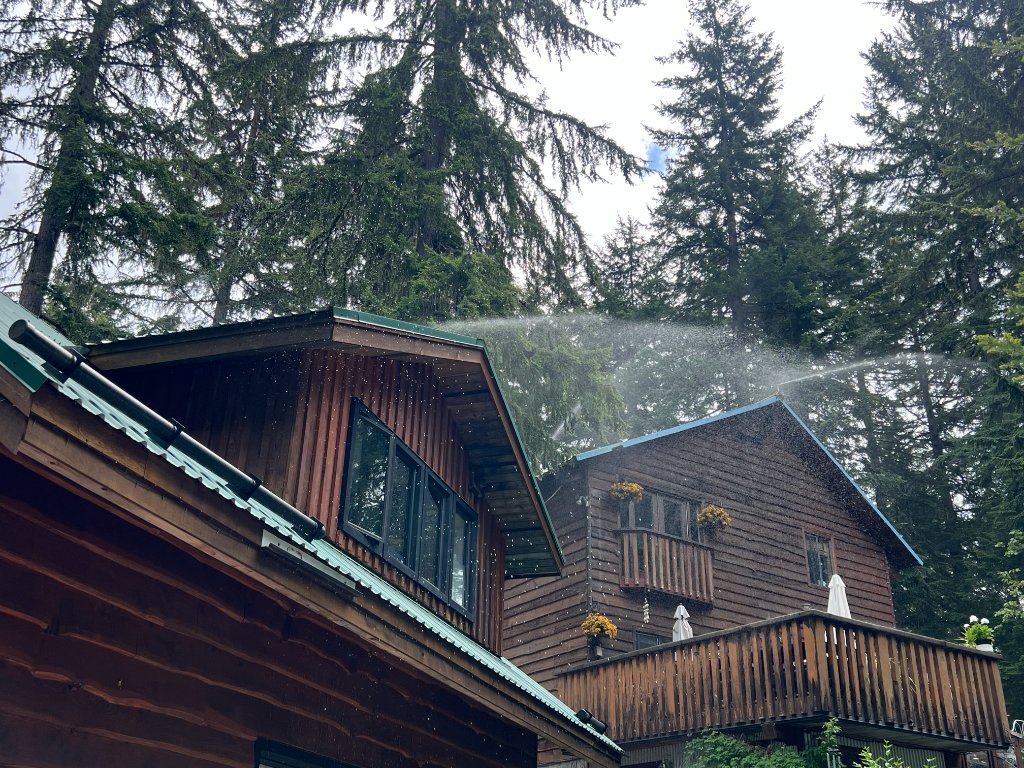
A Prodigy installation on a private residence in Whistler, British Columbia. Every system is designed around the individual property.

The disconnect

Most people don't have that understanding. And it's that disconnect between the science and what many homeowners assume is happening where a wildfire passes through that Prodigy Wildfire Solutions was built to address.

“A lot of people come to us at home shows and insist they’re safe because there are no forests near them,” Lee-Anne says.

“But 90% of structures that burn in a wildfire don't burn because the fire reached them directly. They burn because of embers.”
Lee-Anne van Dongen

Those embers travel on the fire's own weather system. The intense heat of a wildfire creates wind patterns — small rotating ‘mini tornados’ of air that lift burning material and carry it far distances.

They land in gardens and on roofs, and if conditions are right, they ignite. The fire does not need to be in front of your door for destruction to begin.

Nothing off a shelf

Now in its second year, Prodigy designs and installs exterior wildfire suppression systems for homes, commercial buildings and entire towns. No two Prodigy installations are the same.

Every system is custom-designed following a full property assessment that takes in roof materials, siding, the gradient of surrounding land, proximity to trees and hills, and what water resources are already available. Swimming pools, lakes, rivers, bores, dams — if there is water on the land, Prodigy will work with it.

The company uses copper pipework in North America and marine-grade stainless steel in Australia, and builds everything from scratch. Nothing is pre-fabricated and nothing comes off a shelf.

The team behind it

The team behind Prodigy comes from all over the world. CEO George Harris is from the UK and based in Whistler, British Columbia. CFO Steve Johnson-Stott is also from the UK and based in Halfmoon Bay, BC.

Project manager Chris Barrett is from the UK and based in Whistler BC, and built the company's app — a potentially life-saving tool that tracks live wildfire activity, monitors wind changes, flags evacuation routes, and lets homeowners activate their suppression system remotely from their phone, wherever in the world they are.

Lancashire & North West Magazine · Pages 154–155 · Reproduced from the printed edition with the publisher’s permission.

Visit lancmag.com

Behind the feature

What a Lancashire magazine has to do with a wildfire in British Columbia

A company that installs sprinkler systems on mountainsides in Whistler and Victoria has just been read over breakfast tables in Preston, Lytham and the Ribble Valley. That is not a marketing curiosity. It is exactly the point.

Prodigy Wildfire Solutions · Editorial

here is an assumption buried in almost every conversation about wildfire, and it is the same assumption wherever you have it: this is something that happens somewhere else. To other countries, other climates, other people’s houses. It is the assumption that makes a feature in a North West England magazine worth far more to us than a feature in a wildfire trade journal ever could be.

Because the people who already know they are at risk are not the people who lose their homes. The people who lose their homes are the ones who were certain they were fine.

Why this magazine, and why now

Prodigy is a Canadian company with British bones. Our CEO, our CFO and the project manager who built our app are all from the UK — three of them now living and working in British Columbia, one of the most wildfire-exposed places on earth. They did not move there and discover a new problem. They moved there and discovered how badly the old assumptions travel.

The United Kingdom is not a country most people file under “wildfire”. It should be. On 19 July 2022, the London Fire Brigade recorded its busiest day since the Second World War as grass and scrub fires broke out across the capital in record heat, destroying homes in Wennington. Lancashire itself has watched its moorland burn for weeks at a time — Winter Hill in 2018 remains one of the largest moorland fires in living memory. None of that involved a wall of flame arriving down a residential street. It involved dry ground, wind, and heat doing what dry ground, wind and heat always do.

“The people who lose their homes are almost never the people who thought they were at risk.”
Why we said yes to the interview

What we wanted readers to take away

We had roughly two printed pages, and we could have spent them describing hardware. We did not, and the decision was deliberate. Three ideas mattered more than any product specification.

The first is that embers, not flame fronts, are what destroy houses — around nine in ten of them. The second is that distance from the trees is a far weaker defence than people believe, because an ember can be lifted on a fire’s own weather and dropped tens of kilometres away, into a gutter, a woodpile, a gap under a deck. The third is the hardest to hear: Jasper, in 2024, did everything correctly. It prepared, it back-burned, it followed protocol. The wind changed. Preparation is not the same thing as protection.

The part that is not in the article

Every system we build starts with an assessment, not a quote — roof material, siding, the gradient of the land, how close the tree line is, and what water already exists on the property. Pools, lakes, rivers, bores and dams are all water sources. Copper pipework in North America, marine-grade stainless steel in Australia, and nothing pre-fabricated, because no two properties present the same face to a fire.

That is also why the honest outcome of a feature like this is not a sale. It is a homeowner walking outside on a dry afternoon and looking at their own roofline differently: at the gutter full of needles, the firewood stacked against the wall, the vent that leads straight into the roof space. Most of what makes a house survivable costs nothing at all.

Thank you

Our thanks to Lancashire & North West Magazine for the pages, and for treating a subject that could easily have been sensationalised with the seriousness it deserves. And to Lee-Anne van Dongen, who has been having this conversation at home shows, kitchen tables and county fairs for two years — usually with people who arrived certain they had nothing to worry about.

If the feature reached one household in the North West who now checks their gutters before a heatwave, it did more good than any advertisement we could have bought on the same page.

In the feature

The people behind the story

Lee-Anne van Dongen

The voice of the feature

Married to a structure firefighter who deploys with a sprinkler protection unit. Has spent two years trying to close the gap between what wildfire actually does and what homeowners assume it does.

George Harris

Chief Executive Officer

From the UK. Based in Whistler, British Columbia.

Steve Johnson-Stott

Chief Financial Officer

From the UK. Based in Halfmoon Bay, British Columbia.

Chris Barrett

Project Manager

From the UK, based in Whistler. Built the Prodigy app — live fire tracking, wind changes, evacuation routes, and remote activation from anywhere in the world.

Your own property

Find out what a fire would find at your address

The same assessment described in the article — roof materials, siding, the gradient of the land, proximity to vegetation and the water already on your property — run against live fire agency data.